

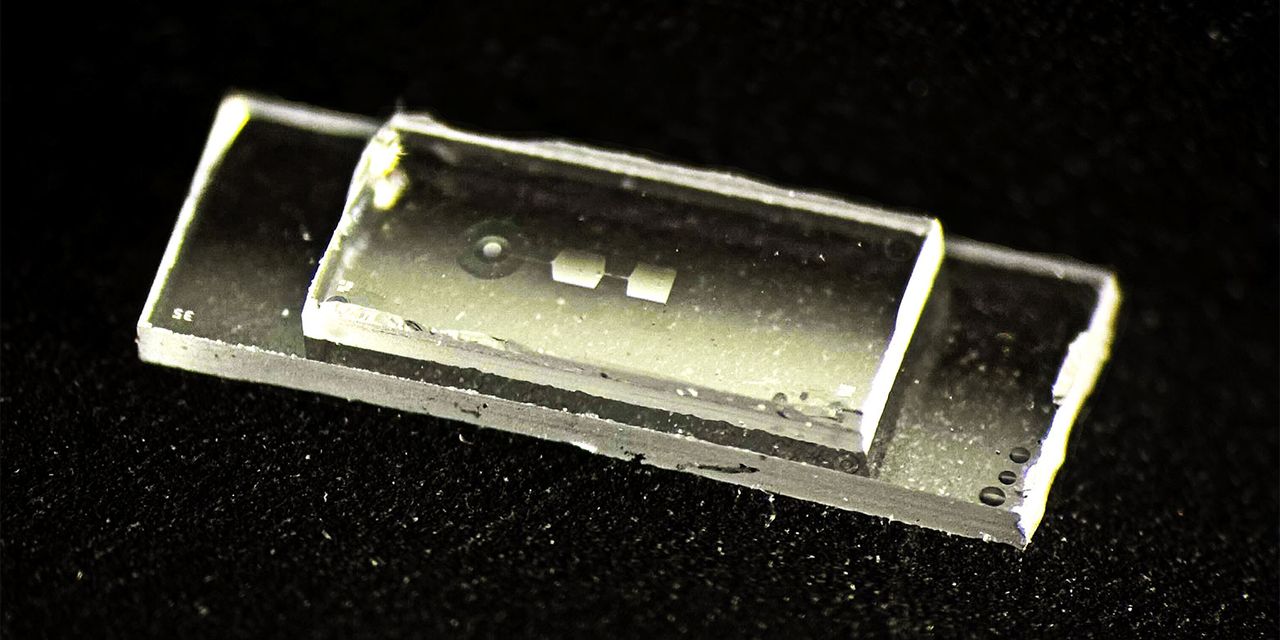
- ETH Zurich quantum chip sees superconducting qubit act as CPU and the vibrational modes of a fingernail-width acoustic resonator serve as quantum RAM
- The approach borrows from classical computer architecture as it completely flips the script on how modern quantum computing might store short-term data
- The team demonstrated a universal gate set and ran small instances of the quantum Fourier transform and period finding
A guitar string essentially stores a note based on how it vibrates, and if one plucks it differently, an entirely different note plays.
A team of researchers at ETH Zurich has leveraged the same principle to build a quantum chip that stores information by replacing the string with microscopic acoustic resonators.
This allows the chip to increase its working memory significantly, essentially increasing the storage capacity, a prohibitively expensive commodity in quantum computing, significantly.
A vibrations-based quantum storage play
ETH Zurich’s research is led by quantum physicist Yiwen Chu, who used tiny mechanical vibrations to both store and process information. The vibrations, however, go far beyond the range of human hearing, happening inside a quantum chip where they essentially replace or complement the working memory of a quantum computer.
The study, published by the Hybrid Quantum Systems group, lists Professor Yiwen Chu, along with doctoral students Yu Yang and Igor Kladarić, as lead authors and focuses on replicating the division of labor seen in a classical computer.
A superconducting transmon qubit serves as the CPU, while the working memory (the quantum equivalent of RAM) is a high-overtone bulk acoustic wave resonator, or HBAR, whose many vibrational modes each serve as a memory slot.
The Qubit essentially swaps a quantum state from a vibrational mode (reads it, in classical computer terms), manipulates it (modifies it), and swaps it back (writes it). This makes for a unique configuration that most modern quantum computers do not follow, in which processing and storage are two distinct segments; most designs treat both memory and compute similarly.
The approach has advantages, however: acoustic waves have wavelengths roughly a hundred thousand times shorter than electromagnetic ones, allowing an entire quantum chip to be extremely small, as the research team states, even if the actual computer will be many orders of magnitude larger.
The chip has passed stress tests, including a proof of feasibility, which also included testing using two of the most commonly used methods to benchmark a quantum computer: the quantum Fourier transform and a period-finding algorithm.
The endgame here, as noted by the research team, is quantum random-access memory (QRAM), which would allow modern quantum computers to access a much larger store of quantum memory than current specifications allow. Whether this pans out depends on both the scalability of the approach and the computational power in play.

